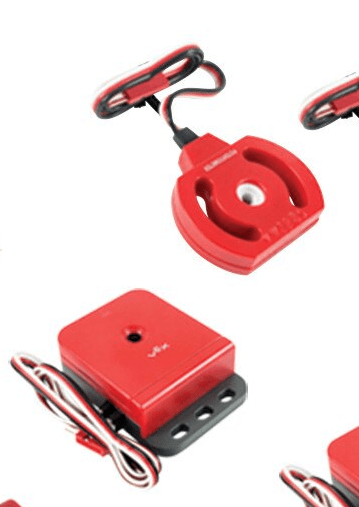
Encoders and potentiometers can be some of the most useful sensors for autonomous control, as they can be used to measure the distance a part moves. This is done by measuring the axle rotation of a shaft, which is inserted inside of the encoder or potentiometer. While both are similar, encoders and potentiometers each have their strengths and weaknesses, and knowing when to use them can be vital in running a robot.

With the release of the V5 Smart Motors, encoders have been inserted into the motor itself, eliminating the need to attach a separate encoder, whose bulkiness proved troublesome when attempting to fit on the shaft. However, the working of the encoder itself remained the same. The axle shaft is attached to a circular disk with slits inserted in the edges. As the shaft rotates, light filters through the slits into a light sensor. The spaces in between the slits blocks the light, and allows the light sensor to determine the rotation and direction of the shaft. Encoders are most often used for the drive trains of robots, which offers a more accurate distance for the robot to travel, rather than using a timer.
Potentiometers have their own way of measuring the rotation of a shaft. When the shaft running through the potentiometer is turned, the resistance on the electical current running through the potentiometer increases, causing the voltage returning to the brain to change. The brain then is able to translate the voltage change into rotation degrees. This way of measuring rotation is more accurate than the encoder’s disk, but only is able to work up to 250 degrees. This is why potentiometers are used more often on mechanisms that have a limited rotation, such as an arm.
 VEX Sensors and How to Use Them
Could you explain into more detail why potentiometers have a limited measurement range (<250 degrees)?
LikeLike